
Lot 314
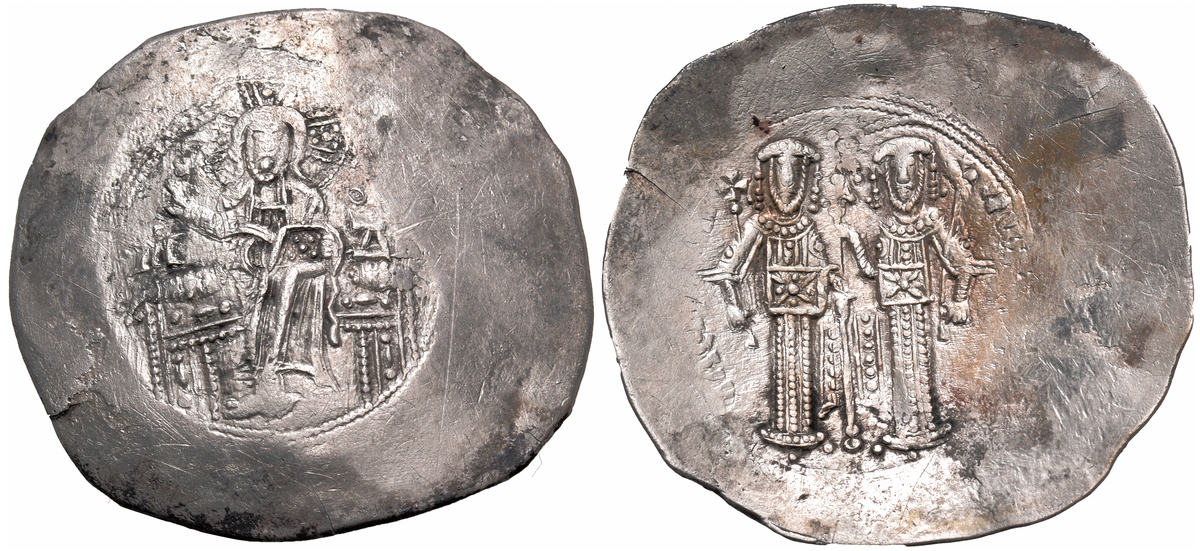
Michael II Comnenus-Ducas, despot of Epiros, 1237-1271. Aspron Trachy (Silver, 29 mm, 2.92 g, 6 h), struck in the name of Alexios III?, Arta. IC-XC Christ Pantocrator, bearded, nimbate and with his right hand raised in benediction, seated facing on throne; above throne to left, X over M; to right [lis] over AK. Rev. AΛΕ[..] KWN[CTANTINOC] To left, Alexios standing facing, crowned, wearing divitision, collar piece adorned with eight jewels, and a loros, and holding a cross-tipped scepter with his right hand; to right, St. Constantine standing facing, crowned, wearing divitision, collar piece adorned with nine jewels, and a loros, [and holding a cross-tipped scepter with his left hand]; both holding between them a labarum, on a long shaft ending in a globe at the bottom, surmounted by a triangular decoration . Cf. Bendall 1 and DOC 1 (but in electrum and with a differing reverse). SB 2230 (as this piece). For another aspron trachy of Michael II, but with a differing reverse, see Nomos 19, 2019, 453. Extremely rare. Some striking flatness, usual edge split, and deposits as found, otherwise, good very fine.
From the collection of a European specialist.
Michael II Comnenus [Angelos]-Ducas, was the son of the first Greek ruler of Epiros, Michael I Ducas (1204-1215), himself the illegitimate son of the Sebastocrator John Doukas. After Michael I's death he was succeeded by his brother Theodore, who not only managed to capture the new Latin emperor of Constantinople, Peter of Courtenay, in 1217 (he died in captivity two years later, probably poisoned), but after capturing Thessalonica in 1224, was crowned emperor by the Archbishop of Ochrida in 1227. In 1230 Theodore, who was on the brink of taking Constantinople, made the unfortunate decision to attack the Bulgarians, who, under their Tsar Ivan Asen II, heavily defeated Theodore at Klokotnitsa; thereupon his "empire" collapsed. Theodore was blinded and remained captive in Bulgaria until 1237 when he returned to Thessalonica; after Thessalonica was incorporated into the Empire of Nicaea 1246 he retired to a castle in western Macedonia, but in 1251 the emperor John Vatatzes took him away to Asia Minor, where he died soon after. In any event Michael II, who had been exiled after his father's death, returned to the Epirote capital of Arta in 1230, along with his wife Theodora Petralipha. Later becoming an Orthodox saint, St. Theodora of Arta, she came from a Norman-Byzantine family descended from Peter d'Aulps, a Provencal nobleman who had accompanied Robert Guiscard to Kephalonia in 1085 (after Guiscard died from a fever in July, Peter then became an officer in the forces of Alexius I). By 1246 Michael II had become the effective ruler of Epirus and much of Thessaly, and in c. 1249/1251 he was given the title of Depot by John Vatatzes. After various vicissitudes Michael II managed to form an alliance against the Nicaeans, marrying his daughter Helena to Manfred of Sicily and another, Anna, to Guillaume de Villehardouin, Prince of Achaia: this alliance collapsed in defeat by the Nicaeans at the battle of Pelagonia in 1259. Finally, in 1264, Michael II came to terms with the Byzantine emperor Michael VIII and died, at long last in peace, in c. 1270/1271.
Current Status
Online bidding closes: 16 Nov 2025, 09:00:00 CET Current Date & Time: 1 Mar 2026, 23:06:02 CET Remaining Time: Closed Hammer Price:12000 CHF
