
Very rare amulet and with unusual inscription
Lot 1119
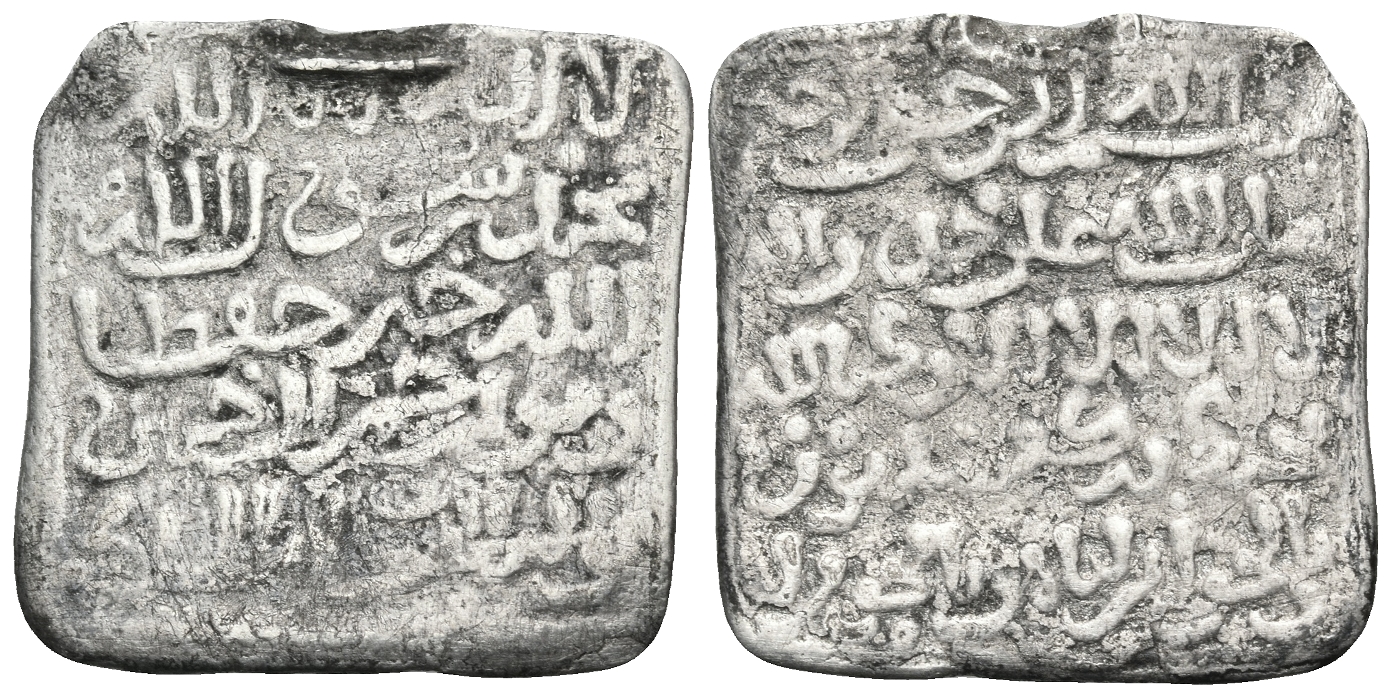
ISLAMIC, al-Maghreb (North Africa). Marinids. Anonymous, circa 1244-1350 AD. Double Dirham (Silver, 26 mm, 2.65 g, 12 h), Used as an amulet. In five lines: لا اله الا الله / محمد رسول الله / الله خير حافظا / و هو ارحم الرحمين / قوله الحق وله الملك (There is no god but Allah, Muhammad is the Messenger of Allah, Allah is the best guardian and the Most Merciful of the merciful, his word is the truth and his is the dominion). Rev. In five lines: بسم الله الرحمن الرحيم / صلى الله على محمد و آله / لا آلاءَ إلَّا آلاؤُكَ يا أللهُ / محيط به كعسلهون / وبالحق أنزلناه وبالحق نزل (In the name of Allah, the Entirely Merciful, the Especially Merciful, May Allah send blessings upon Muhammad and his family, There are no blessings except Your blessings O Allah, encompassing it—Kaʿsahlūn, and with the truth We sent it down, and with the truth it descended). Hohertz 872 (RRR). Album 547D (RRRR). Very rare. Broken mounting, otherwise, good fine.
For the first time, we can clearly interpret the inscription and meaning of this enigmatic "coin" type. Edmund Hohertz read the inscription largely correctly but was unable to understand the third and fourth lines on the reverse: لا آلاءَ إلَّا آلاؤُكَ يا اللهُ / محيطٌ به كعسلهون ("There are no blessings except Your blessings, O Allah; encompassing it—Kaʿsalahūn"). This prayer was traditionally written by certain people during the last Friday prayer of the month of Ramadan in the hope of obtaining protection and blessings.
Particularly striking is the word "Kaʿsalahūn" (كعسلهون), which is unknown and appears to be of non-Arabic origin. It may also be interpreted as a sequence of individual letters (ك ع س ل ه و ن) arranged to function as a kind of magical formula. Many Sunni scholars—if not the overwhelming majority—strongly opposed this type of prayer, considering it an innovation (bidʿah) without any basis in the religion. Some even claimed that Kaʿsalahūn was the name of an idol, inserted by a heretic to deceive the ignorant masses. Nowadays, the prayer is still used in certain Shi'a traditions, as it has been mentioned in a very similar way by the Shi'i scholar al-Ḥasan ibn al-Faḍl al-Ṭabarsī (AD 1077/78 - 1154) in the book 'Makārim al-Akhlāq'.
The Egyptian scholar Aḥmad ibn Muḥammad al-Qasṭallānī (AD 1448 - 1517), who specialized in the science of Hadith (AD 1448 - 1517), writes in his book 'al-Mawāhib al-Ladunniyyah bi'l-Minaḥ al-Muḥammadiyyah': "...Concerning the Protection Prayer (Ḥafīẓah) of Ramadan, 'There is no blessing except Your blessings, O Allah. Indeed, You are All-Hearing, All-Knowing; Your knowledge encompasses it as Kaʿsalahūn; and with the truth We sent it down, and with the truth it descended..." to the end of the text.' Our shaykh said: 'It became well known in Yemen, Mecca, Egypt, Morocco, and many other lands that this is the 'Protection Prayer of Ramadan,' which protects against drowning, theft, fire, and all other calamities. It is written on the last Friday of Ramadan. Most people write it while the preacher (khaṭīb) is delivering the sermon from the pulpit, while some write it after the ʿAṣr prayer. This is an innovation (bidʿah) with no basis. Although it has been mentioned by more than one of the eminent scholars, the wording of some of them even suggests that it was reported in a weak hadith. Al-Ḥāfiẓ Ibn Ḥajar (AD 1372 - 1449) strongly condemned it—so much so that, while he himself was standing on the pulpit during the Friday sermon, if he saw someone writing it, he would denounce the practice..."
It therefore seems clear that this "Double Dirham" was originally intended to serve as an amulet, as the remains of a mounting are clearly visible on most surviving specimens. These pieces were nevertheless produced by skilled die engravers, who may also have worked at the mint. The amulets appear subsequently to have circulated as currency in the form of "Double Dirhams" and could therefore be reused. The existence of worn specimens confirms that they did indeed circulate. Furthermore several very rare examples are known from the Nasrids of Granada using the same forumla on their Double Dirhams alongside with the name of the ruler. It seems that the production of these pieces was simply a pragmatic solution, allowing a single object to serve both as an amulet and as currency.
Current Status
Online bidding closes: 4 Oct 2026, 23:19:30 CEST Current Date & Time: 26 Nov 2026, 20:36:11 CET Remaining Time: Closed Hammer Price:280 CHF by dirham (6 bids)

